

Self-improving AI agents are autonomous systems that enhance their capabilities by iteratively refining their algorithms, learning strategies, and behaviors through self-assessment and adaptation, without explicit human intervention.
Self-Improving AI Agents: The Future of Autonomous Intelligence
~Introduction
Artificial intelligence (AI) has come a long way – from automation to very skilled genetic models. But perhaps the most transformational development on the horizon is the emergence of the self-reforming AI agents system that is able to improve its own intelligence, strategies and behavior without the last external reprogram. This concept marks an intensive change to more autonomous, adaptive and flexible AI systems. In 2025, self-reform agents are not just a theoretical ambition-they become a tangible limit in machine learning, robotics and decision-making.
1. What Are Self-Improving AI Agents?
In the core, self-reform of AI agents is designed to adapt their own algorithms, learning processes and decision strategies over time. Unlike traditional AI systems, which depend on the static model trained on a fixed dataset, these agents can:
-
Reflect on their performance,
-
Identify disabled,
-
Change their internal architecture or training data,
-
And develops to meet better goals.
They embody the concept of meta-learning (“learning to learning”) and are the hallmark of recurrent self-reforming artificial general intelligence (AGI).
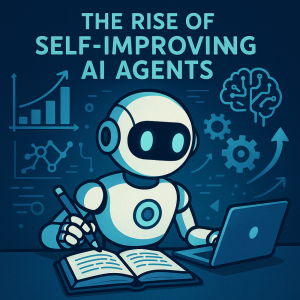
2. Key Components of Self-Improvement AI Agents
To understand how these agents work, we should see the basic columns in their architecture:
A. Meta-learning (learn to learn): The meta learning AI lets AI evaluate how good it is to learn and adjust the methods to learn accordingly. It is often achieved by using:
-
Character-based meta-learning (eg maml),
-
Learn reinforcement with meta control (RL), or
-
Bayesian adaptation technique.
B. Automatic Machine Learning): Automalic agents enable model choices, hyperpame setting and function engineer – without human intervention. Self -improvement agents can run internal automatic loops to limit architecture.
C. continuous education: Unlike traditional AI models, which often “wrong” previous tasks (frightening errors), self-reforming agents use constant learning:
-
Maintain prerequisites,
-
Integrate new information,
-
And customize without retiring from scratches.
D. Self -fishing and development: The most advanced agents go beyond setting in-they can change their codes, back on new data or even spone sub-agents to experiment with alternative strategies, are similar to evolutionary data processing.
3. Real-World Applications in Self-Improving AI Agents
While the region is still emerging, 2025 have seen specific progress and experiments in areas:
A. Autonomous robotics: Robot -like disaster response, warehouse logistics and planetary searches used in dynamic environment:
-
Unknown area friendly,
-
Adjust the motion strategies,
-
Or collaborate with other machines.
B. Individual education system: AI supervisors can now learn from each student’s performance, adjust the teaching methods and over time can create customized teaching routes to improve both themselves and the student results.
C. Financial Handelsbots: Self -improvement agents change algorithm trading by analyzing real -time market conditions, using strategies and even new trading models.
D. Health Services AI: In diagnostics and treatment planning, the AI system constantly refines its clinical decision models by using the patient’s response, real -world results and new research.
4. The Tech Giants & Research Leaders Behind the Movement in self-Improving AI Agents
Many large organizations and laboratories lead this limit:
-
Deepmind: Known for Alfago and Alfazero, their new structures (such as Muzero and Gato) discover self -reform of multiple domains.
-
Openai: Beyond Chatgpt, Openai researches Multi-Agent systems, where agents can learn and develop through collaboration and competition.
-
Mit & Stanford: Top educational institutions learn continuously and bring forward the limits of lifelong AI.
5. Benefits of Self-Improving AI Agents
Infection for self -improvement agents has a number of benefits:
-
Flexibility: They are compatible with changes and unexpected circumstances.
-
Efficiency: Adapt yourself without constant withdrawal or supervision.
-
Scalability: Can handle rapid complex features with minimal human input.
-
Innovation: Novels outside human imagination can detect strategies, models or architecture.
6. Risks and Ethical Considerations in Self-Improving AI Agents
More responsibility comes with more autonomy and potential risk.
A. Insecurity: When agents develop beyond their original programming, their behavior can be difficult to predict or control.
B. Measurement abuse: If an AI changes its goals in unexpected ways, it can continue the consequences of conflict with human interests.
C. Security sensitivity: Autonally modified code opens the door:
-
Unknown insects, or
-
If the self -reform process is compromised, malicious kidnapping.
D. Responsibility and clarity: Self -improvement agents can have consequences or decisions that may not be detected or explained by increasing the concerns in a regulated environment such as health care or law.

Self-Improving AI Agents


